

One of General Dwight D. Eisenhower’s most famous words are ones you may not recognize:
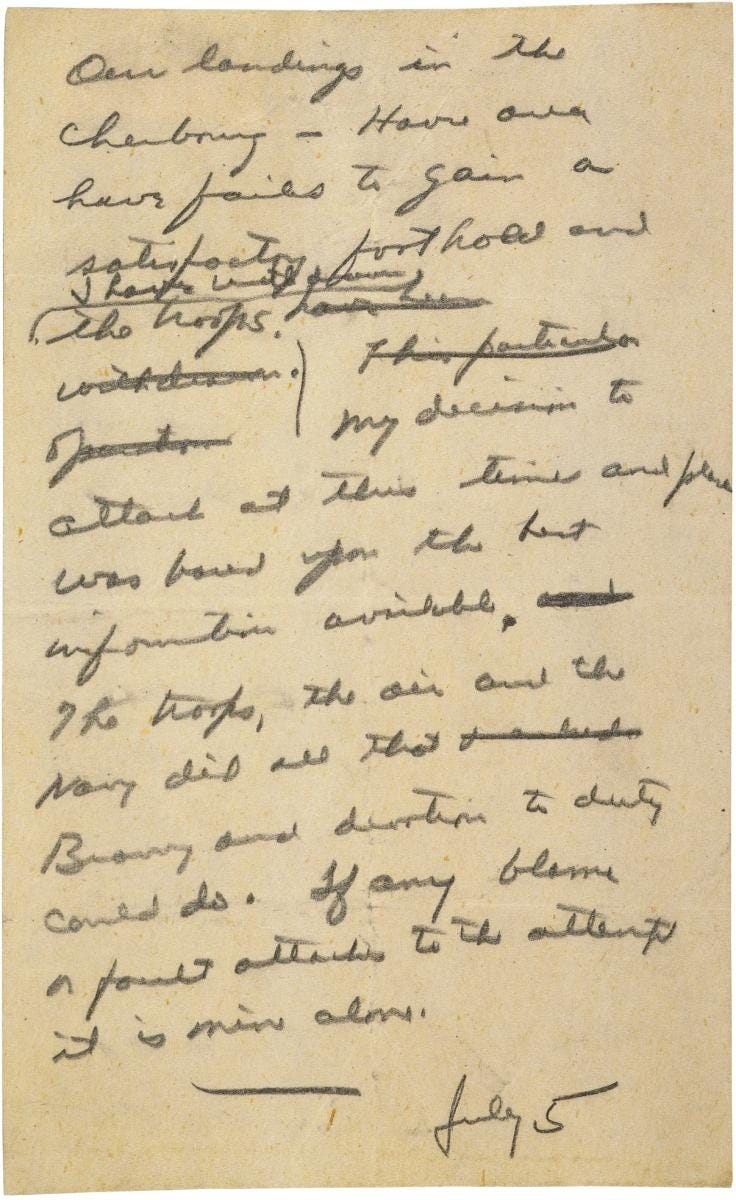
“Our landings in the Cherbourg-Havre area have failed to gain a satisfactory foothold and I have withdrawn the troops. My decision to attack at this time and place was based on the best information available. The troops, the air and the Navy did all that bravery and devotion to duty could do. If any blame or fault attaches to the attempt it is mine alone.”
Have you figured it out yet? If not, you won’t be alone. It’s a letter Eisenhower wrote before the D-Day attack on the Germans in World War II. In fact, it’s a letter that he wrote to be released in the chance that the attack failed.
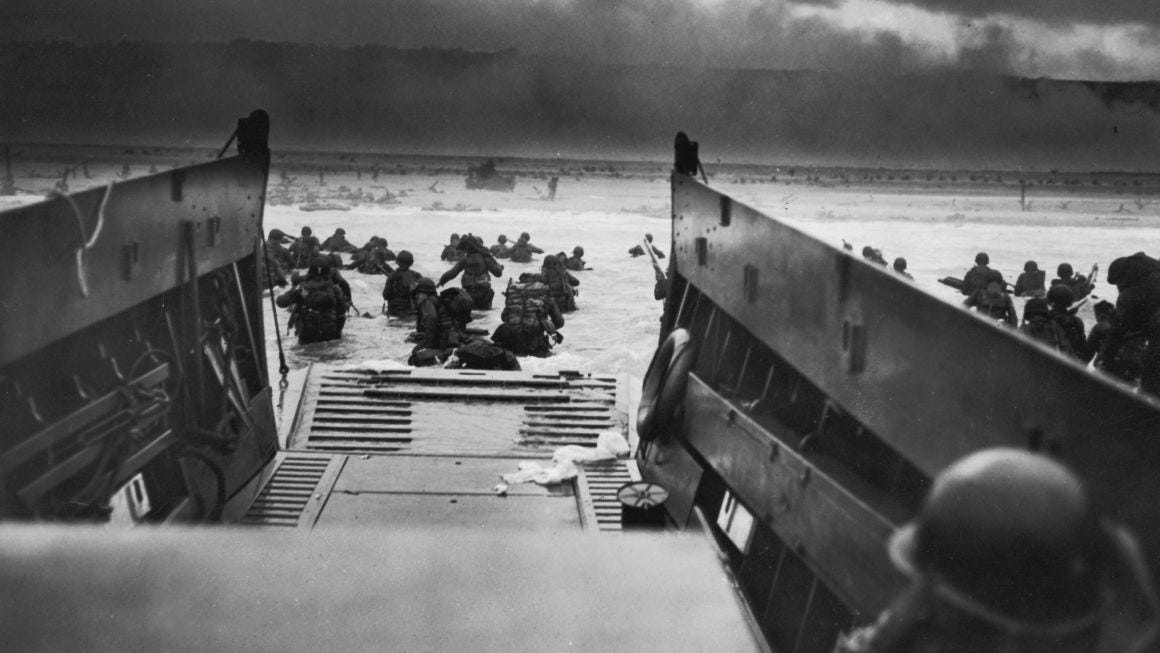
Fortunately, the attack succeeded, despite the loss of over 10,000 Allied troops. But the key line in Eisenhower’s letter gives us one of the most important leadership lessons in history: “If any blame or fault attaches to the attempt, it is mine alone.”
Eisenhower’s hastily handwritten letter ahead of D-Day (with the wrong month penned) shows how seriously he took his leadership role. Source: National Archives
Most importantly, this letter was not released publicly until after his death, when his presidential library uncovered it in their archives. Eisenhower wrote this letter knowing that it would (hopefully) never see the light of day. If it weren’t for his presidential library and the National Archives, we might never have known of its existence in the first place.
Eisenhower’s letter wasn’t symbolic, it wasn’t PR, and it wasn’t retroactive accountability. It was him honestly and humbly accepting his role as a decision-making leader. It shows that leadership isn’t proven by how you claim credit; rather, it’s revealed by how you prepare to accept blame.
Accepting blame is hard. It bruises your ego. “It makes human nature better,” said Abraham Lincoln, “To believe that one human being was perfect – that human perfection is possible.” He was talking about George Washington, but the quote works more generally as well. Everyone wants to believe that they can be perfect, at some level. We want to believe it’s achievable, and we should strive to improve every day. But we are all going to make errors, it’s part of life. And as a leader, knowing how to handle it when it happens speaks volumes about your character.
Accepting the blame and passing on the credit is, in my experience, key to being a good leader. After the U.S. Olympic hockey team won gold in 1980, someone asked coach Herb Brooks why he wasn’t celebrating with them. “They did all the work,” he said, “So they get all the credit.” Ask any of the 20 players about Brooks’ role, and they will forever confirm the immense part he played in their success. But Brooks was a true leader: he stepped away from the spotlight when his team triumphed, allowing them to bask in the glory. Yet, if they had lost, he would have been front and center, accepting the blame.
Admitting mistakes and accepting blame are key traits in a leader. Not only does it allow you to fix errors in a timely manner, but the vulnerability it shows helps bring people onto your side. Those same people will support you when you need it next time.
We’re talking about admitting fault and accepting blame here, which is important. But there’s another, more poignant leadership trait that hides in Eisenhower’s letter: prevention. It’s perhaps the highest form of leadership. The best leaders reduce the need for heroics in the first place by ensuring crises don’t become existential. He wrote this letter hoping no one would ever read it. It’s not so much what he wrote in the letter that shows his leadership – it’s the fact that he felt he needed to write it in the first place. He was willing to let that letter disappear into the annals of history. Taking blame to him wasn’t a public relations strategy, it was just the reality of how he thought. But more importantly, the letter was part of a larger strategy of preparation. Eisenhower was one of the great generals in American history, because of this type of behavior. He prepared diligently, took blame when he failed, and passed along credit when he succeeded.
Behavior like this helps create stability, which is important for a small business. Stability can look like stagnation from the outside. But inside, people like stability. It proves there is a steady hand running the ship and it’s usually the result of someone quietly doing their job extremely well. I’ve written before about how good leadership often lurks in the shadows. Almost all decisions you make as a leader are made quietly. Most leadership only ever happens in private – only a minority of your decisions are ever made public. Because of this, restraint can often be a better decision than action. What is left unsaid is often more important than what is spoken. And what is not done can have a greater impact than what is.
Restraint can take many forms as a small business leader. You can choose not to fire someone after they’ve made a mistake. You can make a deliberate decision not to expand. You can choose not to assign blame when disaster happens. These decisions may not feel like leadership in the moment, but the key is that these decisions are rarely applauded. They don’t show up in monthly or quarterly financial reports. And they often don’t even feel that bold in the moment. But more often than not, these “invisible” decisions matter more than the ones that become public.
There’s an old joke from the British Foreign Office. A civil servant said, “Every morning, I went to the Prime Minister and assured him there would be no world war today. And I am pleased to note that in a career of 40 years, I was only wrong twice.” It’s a humorous parable, but it shows that a good leader works to prevent bad things from happening in the first place, rather than simply accepting the blame after the fact. The most consequential leadership decisions are made before failure, before credit, and often before anyone knows they happened. It can often feel unsatisfying, or even annoying. But no one needs to be told that everything’s fine – they can sense it.
Those in the public eye and those with big egos often think that leadership is about performance. It’s not. Leadership is revealed in preparation. The absence of a disaster should not simply be an accident. And when there is a crisis, do you stand in front of your team, or hide behind them? At the end of the day, leadership isn’t proven in the moments everyone sees. It’s proven in the moments that never need to arrive in the first place.
One of our core values is "Remarkable Responsibility." We try to surround ourselves with people who are quick to raise their hand and say, "Yup, this one was on me." Not ascribing to this value means a short tenure. In leadership, yes. But also top-down, right?