

Everyone loves a great motivational moment that showcases leadership. Think “They may take our lives” from Braveheart, or Leo DiCaprio’s rousing sales speech in Wolf of Wall Street. The problem is, real leadership is never that satisfying. Anyone who has run a business knows that there is rarely, if ever, a moment when you rile your people up to the point of applause just by giving a speech. And even if that does happen, the next day everyone has already forgotten about it.
Real leadership happens in stages. It happens over a long period of time. It’s something that shows in action, rather than a few inspirational words. It takes years to fully develop a leadership style and have people recognize and respond to it. Sometimes it happens intentionally, sometimes it happens accidentally.
When I want to learn more about leadership, I tend to go to look toward some of the best leaders in corporate history. The obvious example is Warren Buffett, the long-time (and now former) CEO of Berkshire Hathaway. Buffett’s annual shareholder letters were legendary. He always had a tidbit or two about management, leadership, and decision-making that stuck with me. I read his letters religiously each year when the company released it. One of his best lines is, “You only find out who is swimming naked when the tide goes out.” Meaning, when times are good, everyone seems brilliant. It’s only when times are bad that you truly know who has it under control.
One of Buffett’s most brilliant leadership moves was in how he structured the Berkshire corporate office. Their website lists 68 subsidiaries it fully owns, but it is believed that over 80 companies are currently owned by Berkshire, including GEICO, Benjamin Moore, Sees Candies, Duracell, and more. That doesn’t even count the enormous percentage of some public companies Berkshire owns as well, including 27% of Kraft-Heinz, 21% of American Express, 9% of Coca-Cola, and more.
It’s believed that Berkshire employs nearly 400,000 people across its entire web of operations. Yet, only a couple dozen employees staff their corporate headquarters in Nebraska. This is a company that oversees over $400 billion of annual revenue. It’s the 13th-most valuable company in the world at the moment. And they have just over 20 staff members overseeing it.
Why do they do this? According to Buffett, because it makes micromanaging nearly impossible. It’s difficult enough to micromanage one company – trust me, I’ve watched it happen many times throughout my career. But to micromanage scores of companies, some of whom are doing over a billion dollars of annual revenue? That’s just nuts. Buffett’s mantra is to hire good people and trust them. And he ensures the alternative is impossible by keeping the headcount to a bare minimum. At first glance, one would think that takes some hefty cojones. But after thinking it through, it makes perfect sense. Why would you hire someone if you are just going to second-guess their decisions?
Another executive that I’m fond of is JPMorgan Chase CEO Jamie Dimon. He’s led the world’s largest bank since 2005, an enormous reign in an industry where leadership turns over much more often than 20-plus years. Forgetting how successful his own company is, world leaders and economists look to him for guidance. He was even rumored to be in the running for U.S. Treasury Secretary or the chairman of the Federal Reserve, before he made it clear he wasn’t interested. In an era where high-powered financial world leaders are usually lambasted, Dimon has the respect of nearly everyone.
And it’s not an accident. I’m convinced the reason is because of his patience and his humility. He understands that he doesn’t know everything. He doesn’t try to convince anyone he does. And he shows legitimate interest in learning not just from those around him, but from people many rungs beneath him.
In a recent interview with Fortune, he said, “There’s a humility about learning. Every day, if I need to know something, I have to call you up to find out. I’m not an expert in everything that takes place in the company. If you get arrogant, complacent, a lack of curiosity, you’ll kill the company.”
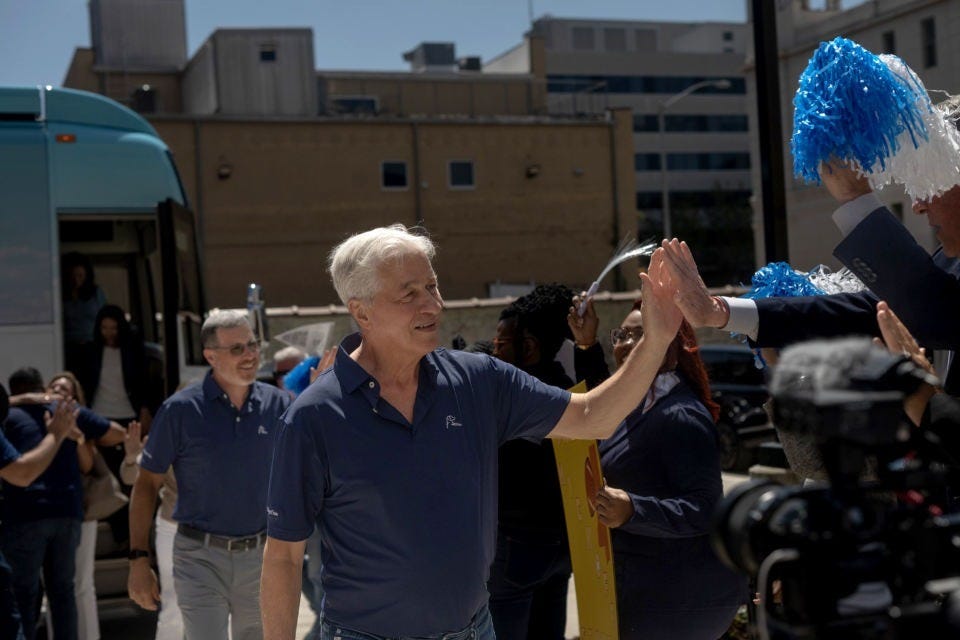
But more importantly, his actions speak louder than his words. One of the tidbits I learned over the last few years is that Dimon and his executive team go on an annual bus tour to visit a bunch of Chase branches in a region of the country. And it’s not just for show. Sure, it starts as a giant pep rally to get everyone excited. But afterward, he sits down with everyday employees to find out what the company can do better. He wants to see them in action, how they work, to get ideas for improvement.
In a Wall Street Journal feature covering the 2025 tour, he explained that the first time they did this, they returned to headquarters with “over 1,000 things to fix. I’m not kidding.” Leadership may happen from the top, but it has to start from the bottom. You can’t lead without knowing what needs to be done. And you know what needs to be done by learning from people at every rung of the ladder, especially those on the front lines.
Now, in the same Fortune interview, Dimon also joked, “Management is a lot of fun, except for two things…customers and employees.” And while I certainly identify with that mantra1, the reason he can joke about that is because his customers and employees know that he truly cares about them. They know he takes the time to learn from them. They know he relies on them to make the company better, that he can’t do it himself. And they know that he will do everything in his power to make improvements to the company they devote their time to.
Dimon and Buffett didn’t create their aura in a day, a month, or even a year. They did it over the course of many years of putting in the work, often quietly, in order to achieve their company goals. And people see that work. You don’t need to tell them you’re doing it or advertise the fact. Actions speak louder than words, but those actions need to occur consistently and over a long period of time.
Most of us will never write an annual shareholder’s letter or go on an annual bus tour throughout America. So how does this scale down for those of us in small businesses? First, by recognizing the obvious: leadership often feels unsatisfying because it often looks like you’re doing nothing special. Leadership isn’t developed with big displays of bravado. It’s done with baby steps that are sometimes imperceptible to anyone else – even yourself. But if you’re doing it properly, one day someone around you will think, “Huh, how did we get here?” and realize the effect you had on the direction of the company. That’s how loyalty is built: you show people the way, and give them the space to follow.
And Buffett is right: great leadership is recognized only after the tide goes out. Dimon was a lifeline for the entire economy, let alone his own company, during the 2008 financial crisis. He held everything steady and continued to grow in the face of massive roadblocks. I recall a few times during my career when things were rough, and everyone in our building knew it. It was those times where I often gathered segments of my staff, or even the entire company, to make sure everyone’s concerns were heard. Were we on the right track? Was the rough patch something we just had to wait out, or did it require significant decision-making or evolution? Just asking these questions and listening to what people have to say helps make them know you’re working on their behalf.
Because of pop culture, we often cling to illusions of leadership that resemble dramatic episodes. Whether it’s a single decision that comes to mind with a shout of “eureka!” or a verbal brow-beating to get someone to do what’s necessary, many people believe in these fictitious ways of getting to the top. But that’s simply untrue. My most important moments of leadership generally occurred within the quiet of my own office, or even amidst something I chose not to do. That’s why leadership often feels unsatisfying in the moment. You rarely feel it working until months or years later.
Maybe add vendors to that list as well.