

Apple recently announced that longtime CEO Tim Cook would be stepping down from his role and assuming the title of Executive Chairman. By the time his tenure is done in September, he will have served in Apple’s top job for over 15 years.
Cook was one of those few big business leaders that I looked up to as a small business leader. He was someone whose style and expertise really translated to the smaller companies that I’m used to running.
The Alabaman was Steve Jobs’ hand-picked successor, chosen while Jobs was in his final months battling cancer. Cook spent many years working at IBM and Compaq before joining Apple. He worked on the supply chain side of the company and eventually worked his way up to COO, where he served under Jobs for many years. He became a close and cherished confidante of the Apple founder.
Cook led Apple through one of its most financially-successful eras. Apple’s stock rose by about 2,000% during Cook’s tenure, growing the size of the company from $350 billion to $4 trillion. But he was oft-criticized by Apple faithfuls, specifically those that had a soft spot for Jobs’ design and product expertise. That criticism was loud enough to inspire an entire book arguing that Apple “lost its soul” under Cook.
Now, I’m not touching the “soul” part. I’ve never worked for Apple, nor am I the kind of person who analyzes the ridges and curves of each new iPhone version like it holds a clue to the Ark of the Covenant. But I am interested in how a company evolves over years and through generations. And Cook was inarguably one of the most successful company leaders of my lifetime.
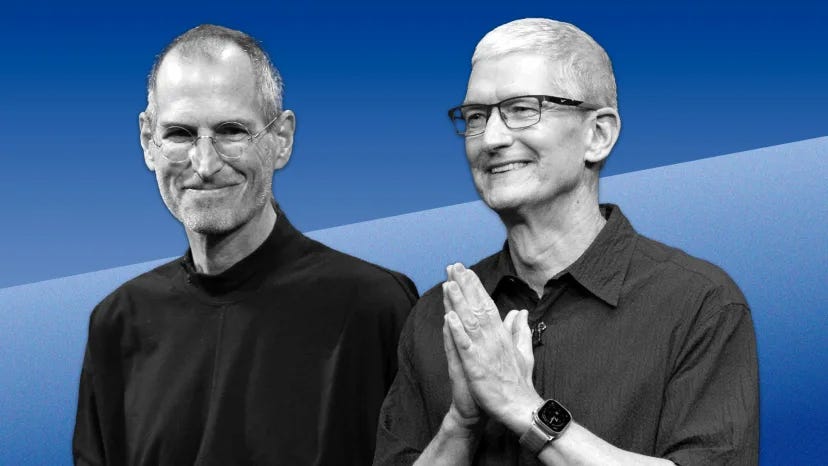
Jobs was indeed a product genius. He opened the world’s eyes to the types of product we’re now used to seeing each year from Apple. And Jobs knew that wasn’t Cook’s specialty. So why would this “genius” want someone that his own fans didn’t trust?
Because Jobs knew that the next stage of Apple’s evolution was to focus on its operations and make the company more efficient. That’s what Cook spent years doing under Jobs, and it’s what Jobs knew the future held for his own company. Cook’s greatest contributions are largely invisible. It’s unnoticeable to consumers, but crucial to Apple’s success.
I’ve written before about the importance of focusing on operations in small business, and Cook’s success shows why.
One of Cook’s biggest successes in Apple was in how he strove to eliminate as much inventory as possible, so that Apple could free up more cash. Early on, he asked his staff how Apple could increase product turnover from 12x to a higher number. When they offered suggestions, he asked them how they could increase it to 1,000x. The number is apocryphal, but it shows how serious Cook was at creating efficiencies. He eventually overhauled the way Apple fulfills customer orders by completing the manufacture of products to order and shipping direct from the factory. In this way, Apple never actually had the inventory on their balance sheet: the customer pays Apple for a product, Apple’s vendor completes the build of that product, and then ships it to the customer. In this supply chain, the inventory never technically enters Apple’s ownership.
Most businesses think inventory is what enables sales. And that is sometimes true. But in the case of a manufacturer, it could be something that gets in the way of cash. That’s how Cook looked at Apple. Inventory isn’t just a balance sheet item. It’s a collection of decisions you’ve already made that you can’t undo. If it’s not in your inventory in the first place, but rather a part or two away from completion, you can offer more customizations to your customers without having to actually stock each version.
Operations were secondary under Steve Jobs, who was the product and marketing genius. But Cook, under Jobs’ tutelage and then on his own as CEO, turned the operations into Apple’s primary driver of profit, speed, and customer experience. He utilized his relationships with suppliers and made some brilliant moves, including: prepaying for capacity in order to lock in priority access; concentrating its volume with fewer suppliers to ensure it was the priority customer; making Apple too important for its vendors to ignore. There is definitely a benefit to spreading purchases across multiple suppliers, to not put your eggs in one basket. But the flip side of that is that it may not give you the power to negotiate better terms for yourself. Most small businesses won’t replicate this at Apple’s scale. But the principle still applies: the more important you are to your suppliers, the better your position.
How is this relevant to small business? First and foremost, Cook preached inventory discipline. Are you holding product “just in case”? Is too much product just sitting on your shelves? What product do you still stock because it used to sell or it has some personal or nostalgic meaning to you, even though it may not be pulling its weight anymore?
Cook also preached speed over stock. Can you place smaller orders, more frequently with your suppliers? Is your product something that can be customized later in the process? If either or both of these are true, you can increase your cash flow immensely by only pouring money into inventory as soon as you need it. In some cases, like Apple’s, you may be able to design the process in a way where your customers pay you for the product before you even have to pay to complete it.
Moreover, Cook showed us how important operations truly are. If your sales doubled tomorrow, would your systems hold? Or would they break? Multiple times in my business’s life, an explosion of sales nearly broke the company. It led me to double down on efficiencies and operations in order to ensure we could always handle an increase in business, no questions asked.
Lastly, Cook was laser-focused on cash flow awareness. Apple’s financial strength is its cash flow. Even when sales are stagnant, or they don’t have the hottest new product, their cash flow is the envy of the retail world. Apple’s cash flow has grown dramatically since Cook took over, and even in leaner years, still hovers around the $100 billion mark. None of us have that many zeroes on our financial statements, but the lesson still stands: cash flow reigns supreme.
The downside to someone like Cook is that he indeed seemed to take fewer risks with regards to product development. But he did what he was hired to do: he made Apple more efficient, more profitable, more nimble, and grew it into one of the most financially-powerful companies of all time. There’s a reason Steve Jobs handpicked Cook to be the heir to Apple. Jobs built Apple’s products and made the company iconic. Cook built the system that put those products into consumers’ hands within days.
Tim Cook is often described as the man who followed Steve Jobs. And to hardcore Apple fans, he is often the one who “lost Apple’s soul”. But that framing misses the point. He was never supposed to be Steve Jobs v2. His strength was operations and logistics, and he utilized that expertise to rebuild Apple around an entirely different strength. A business leader can not be everything to everyone. And Cook never tried to be. Most businesses treat operations as a support function. Tim Cook treated it as a strategy.
So, in his final months as Apple CEO, I salute Cook and the lessons he has for all business owners, not just the publicly-traded ones. Vision is important. But what is more important is someone to put it into practice.
Honestly, I admit I never thought an SMB could learn much from such a gargantuan, cash machine like Apple, but you make good points. It has me convinced I need to look at how we handle inventory at one of my businesses, maybe even borrowing a few of these strategies. Thank you for this post.