

Every business needs a reason for customers to choose them over someone else. When you’re just getting going, or even when you’re established and looking to improve, you essentially have three levers you can pull at a macro-level: cost, quality, and speed. Many entrepreneurs spend their years trying to be all three of these.
The problem is, it’s almost impossible to do that, especially if you’re taking a long-term view of your business.
Enter the “iron triangle,” as it is sometimes known:
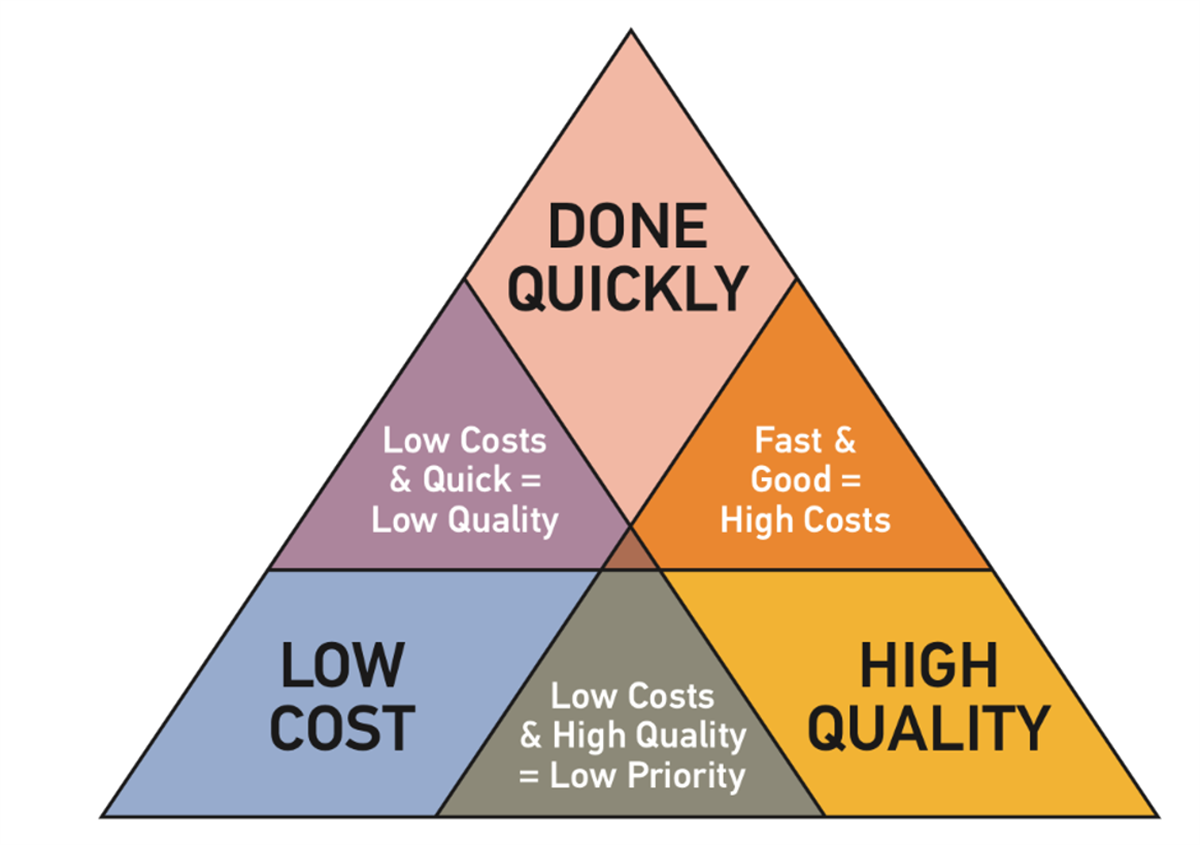
The theory behind this oft-talked about pyramid is that you can only choose two of the three. That leaves three options for what your modus operandi – or MO – is as a business. Does your company do cheap and fast? Good and cheap? Or good and fast? Those are really the only options when you want to make a long-term business plan.
Think of any major corporation: they have to fall within two of these, and no more. Apple is good and fast. IKEA furniture is good and cheap (speed is sacrificed by forcing the buyer to build it). Costco is good and cheap. Dollar General is cheap and fast. McDonald’s is cheap and fast (though its staunchest fans would argue it is good as well).
Try to think of a company that accomplishes all three over a long period of time. It’s nearly impossible to come up with one. Amazon is the closest: they spent the earliest years of its life dabbling in all three parts of the triangle. But it also didn’t start making money until many years later. Fast forward to today, and its advantage is its speed and its service. Amazon continues to have the reputation for being the cheapest, but check some household staples: Amazon is almost never the lowest-priced anymore. But it can get that more-expensive product to your house in a couple hours, something no one else can do.
The reason the triangle exists is simple: every improvement in your business costs something. Faster delivery requires more inventory, more employees, and more space. Better quality requires better materials and better training. Lower prices means sacrificing something else. Every business has the choice of where they want their strengths to be.
The trickiest part of the triangle is “good.” If you want to be the lowest-priced, just sacrifice your dollars elsewhere. To be the fastest, you need to pour money into your operations and your staff.
But “good” doesn’t always mean higher quality. It can mean one of many things. If you’re a manufacturer, it indeed means the quality of your product. But if you’re a retailer, it means the shopping experience and customer service. If you’re a service provider, it’s the quality of that service or your reliability. An expensive plumber has to provide a better fix for your leaky faucet than the new, lower-priced guy down the street. A dollar store has to be cheaper than Target. A MacBook has to be better than a Chromebook. Sometimes good can be as simple as making your customer’s life easier.
Essentially, what this boils down to is, why will customers go to you instead of someone else? What gives them a reason to patronize your business over your competitors? You need to be able to establish your MO and stick with it, through good times and bad. If you end up chasing the third part of the triangle, you will almost always fail.
In my business, we focused on speed and quality (in our case, service). We always worked to ensure that orders got out the door as quickly as humanly possible by investing more in our operations and our people. We also wanted our customer service to be top notch: no robotic menu on the phones, just a human answering on the first ring. Emails answered quickly and properly. We spent money on inventory so customers didn’t have to wait long for goods. All of these choices meant that our pricing would be higher than that of our competitors. But those choices were also why customers stuck with us for so many years.
Many of our successful competitors chose different corners of the triangle. They sacrificed speed or service in order to be lower-priced. That worked for many of them, as is evidenced by their own successes parallel to ours.
There were also a handful of competitors over the years that attempted to satisfy all three corners of the triangle. They all ended up bankrupt at some point.
Not for us, though. We recognized that in order to be excellent, we couldn’t also race to the bottom when it came to price. Instead, we followed a formula followed by millions of other businesses, including many of those we did business with.
One company we admired for many years was A. Duie Pyle, a trucking company that has been in business since 1924. They weren’t always the cheapest, and they also didn’t service the entire country. But where they did have service in the Northeast, they were fast and efficient. Their customer service was excellent. Their current owner, Peter Latta, once said in a piece in the Philadelphia Inquirer: “We encourage our customers to see that price is only one component of cost.”
I couldn’t have said it better myself. I’m biased, of course, since his business MO matches what ours was for 50-plus years. But it rings true: just because you pay less doesn’t mean it costs less. What you lose in quality or service often will make up the difference. You can buy the dishwasher that’s 20 percent cheaper, but if it lasts five years versus ten years for the more expensive brand, you’ve actually lost money.
You can order the cheaper option from overseas instead of from a domestic business, but it’s going to take weeks or months to get the same item that you would’ve otherwise had tomorrow.
Neither of these options are wrong, mind you. What is wrong is not taking those trade-offs into account when you’re on the customer side. I am also not saying to pick the most expensive option every time as the customer. I am saying to consider the entire cost of every option including: your time, your focus, and the opportunity cost. Quite often, the option to “save money” ends up costing you a lot more.
And on the business side, remember that customers don’t need you to be everything. It’s better to be exceptional at a few things than average at everything. Once you decide what it is at which you want to be exceptional, it’s simply a matter of executing it. Every successful business has an MO. The trick isn’t finding all three corners of the triangle. It’s choosing the two that matter the most to you, and becoming impossible to beat at each one.
Preach. I've been making a similar point about health-care systems for years (cost, accessibility, quality...pick which two you want!).