

Bear with me as I take you down a hockey rabbit hole.
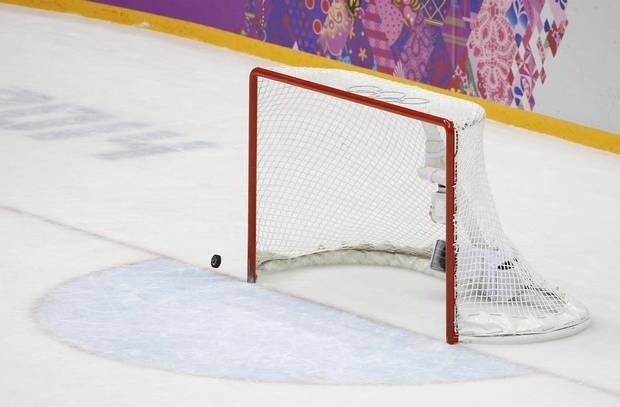
Hockey is a game played with five skaters on the ice for each team, plus a goalie. That’s 12 total players at any given time. However, a team has the option to “pull the goalie,” meaning the goalie skates to the bench, and a sixth skater jumps on the ice. While that leaves the net empty and open for the opposing team to score, it also gives the team with six skaters a man-advantage, and a higher chance to score. It’s a high risk, high reward strategy, usually utilized at the end of a game when a team is desperate to score.
The idea of this is that, if you’re losing by one goal, you need to make a really hard push and do anything possible to tie the game. Whether you lose by one goal, two goals, or ten goals, it’s still a loss. You don’t get additional points in the standings depending on your winning margin. So, as backwards as it might seem, late in a one- or two- goal game, teams would historically heighten the chance of conceding a goal in order to raise the odds of scoring a goal themselves. It’s why the last minute or two of a one-goal hockey game is often incredibly exciting. Everyone is pulling out all the stops, on both teams.
The problem with this is that, for decades, hockey coaches would only pull their goalies in the last minute of a game, and no earlier. There are a variety of reasons for this: perhaps a coach trusts their team may be able to tie the game without the extra skater. Maybe the coach doesn’t think the extra skater gives their team that much of a better chance to tie the game. More likely, however, is that subconsciously coaches are terrified of the perception of what could happen if they pull their goalie too soon. While it’s technically true that losing 3-2 or 10-2 is the same thing, no one wants to be on the losing end of a blowout. Especially in a career where job security is minimal, coaches don’t want to stand out for poor decision-making. Instead, it’s better to take the safer route, perhaps give up one empty net goal, and move on to fight another day.
But over the last 15 years, there has been a push in hockey (as in all sports) to utilize data and analytics for better decision making. One of the strategies that kept being pushed by analytic nerds was that coaches should be pulling the goalie much earlier than they had historically. Unsurprisingly, most coaches (hockey being an old-school sport amidst an old boys club) rejected this data.
Then, in 2018, an unpublished paper by Clifford Asness and Aaron Brown made the rounds in the hockey world. They dove deep into the data and found that, on average, coaches pulled their goalie about three minutes too late when down a goal. They found that if a team was down one goal, the ideal time to pull their goalie is with just over four minutes left in the game. If they were down two goals, they should pull the goalie with 13 minutes left in the game. Down four goals, the data shows the goalie should be pulled the entire game.
Their data showed that, on average, a team is more likely to score a goal than concede a goal with the goalie pulled. So, while you may lose a bunch of games with this strategy, you’re more likely to win in the long-term. In fact, the researchers found that utilizing this strategy would earn an average team four more points per season. That may not seem like a lot over an 82-game season, but this past season four points would have been enough for two teams to make the playoffs that ultimately didn’t. In the 2023-24 season, it would have been enough for three teams. That is the difference of millions of dollars of revenue, perhaps another year or two of job security for a coach or player, and increased happiness of the fan base.
Even so, it took teams many years after this research to actually change the way they did things. Now, teams certainly are willing to pull their goalie much earlier – not quite with four minutes left, but definitely earlier than they used to. Hockey is a conservative, slow moving business – it takes a long time for people to change their habits. But in the meantime, dozens of players, coaches, and general managers likely lost their jobs because of their inability to change their habits. “This is the way we’ve always done it.”
This trap is something that has not only bothered me for my entire career, but is also one I’ve found myself falling into as I get older. It’s incredibly easy to just stick to the status quo, since change is often so complex, especially in business. When I was younger, I would push back against these “ways”, because I wasn’t a part of the decisions in how we did those processes. Nearly 15 years later, there are processes that I put in place that may need changing. And I certainly find that it’s much harder to change something that I’ve implemented than it is to change something that someone else implemented.
Yet, this is how a business stagnates. As business leaders, our job is to always keep growing, to always keep improving. Just because we made a process more efficient last year, doesn’t mean we can’t continue improving it this year. Just because we spent money on a solution a few years back doesn’t mean there isn’t a better option (which also costs money) right now.
There are endless examples of this in the sporting world, including how baseball uses their pitchers; how football coaches choose whether or not to “go for it” on fourth down; how soccer players take or defend against penalties. There are also a plethora of examples that you can find just by diving into your business’s operations. Most of us aren’t in denial about what processes or strategies we use that are outdated. It’s simply that we often don’t want to make an adjustment, because something new and unknown is terrifying. It’s the principle of “the devil you know.”
This is the part where I usually try to give advice or suggestions on how to avoid falling into some trap. But to be honest, this is one that is incredibly difficult to do. There’s no secret recipe for getting past “the way we’ve always done it.” More often than not, you simply need to step to the edge of the cliff and just jump. There’s no way around it. Especially for larger changes, it can be terrifying and anxiety-inducing. But if you want to progress, improve, and continue growing — not just in business, but also personally — you often have no other option.
Pull the goalie.
We need a "Moneyball" for hockey about this ...