

One of the biggest misconceptions about intelligent people is that they are immune to basic human biases. It’s easy to assume that a smart person, an academic, a corporate leader, or anyone else who has experienced great success is able to avoid these psychological pitfalls.
It’s simply not true.
Intelligence does not make someone immune to bias. In some cases, it can make bias harder to detect because intelligent people are often better at constructing arguments for conclusions they already believe.
The truth is that humans don’t experience reality directly. We interpret reality. And those interpretations can be wildly different depending on many factors.
Take sports, for example. If you show the same clip to fans of opposite teams, they will have wildly different viewpoints of what occurred. This has been written about for decades, and can easily be replicated by walking past any sports bar the night of a big game. The fascinating part is that a lot of sports fans know they are biased. A Philadelphia Eagles fan watching a controversial penalty does not believe they are seeing an objective replay. They believe they are seeing the truth. The same psychological process happens everywhere else in life. The difference is that in politics, business, and personal relationships, we rarely acknowledge that we are wearing a jersey. Sports fans have obvious rooting interests, but the result of a sports game doesn’t materially change anything around us.1

Let’s look at something that does materially matter, like how judges dole out rulings. Research has shown that the closer a morning gets to lunchtime, the less generous judges tend to be when deciding on bail for a defendant. Why’s that? Because they’re hungrier. Years of education, hundreds of thousands of dollars of law school tuition, and decades of experience. And a potentially life-changing decision depends on whether or not the judge’s stomach is rumbling. There’s no level of intelligence or education that can account for basic human needs.
There are so many examples of this. Your wage happiness is not necessarily tied to your actual salary, but often your salary relative to those around you. An annual pay of $200,000 looks great on paper, but if your colleagues are making $250,000, you’re going to be more disgruntled than the same person whose colleagues are making $150,000. Likewise, workers in a company can claim they were much more productive with a remote schedule, whereas managers at the same company report that productivity is down when staff is remote. The same job candidate can look great or terrible depending on just the first few seconds of the conversation – we all know the effect that first impressions have. And what about the millions of people who swear they can tell the difference between Coke and Pepsi, yet when you place three cups of cola in front of them they do no better than chance?
We all tend to think we’re better than human nature and human bias. But the more stories you read, the more data you look at, the more it’s incredibly clear that the opposite is true. Nowhere is this more apparent than when political identity is involved. Take a look at this recent chart from Gallup:
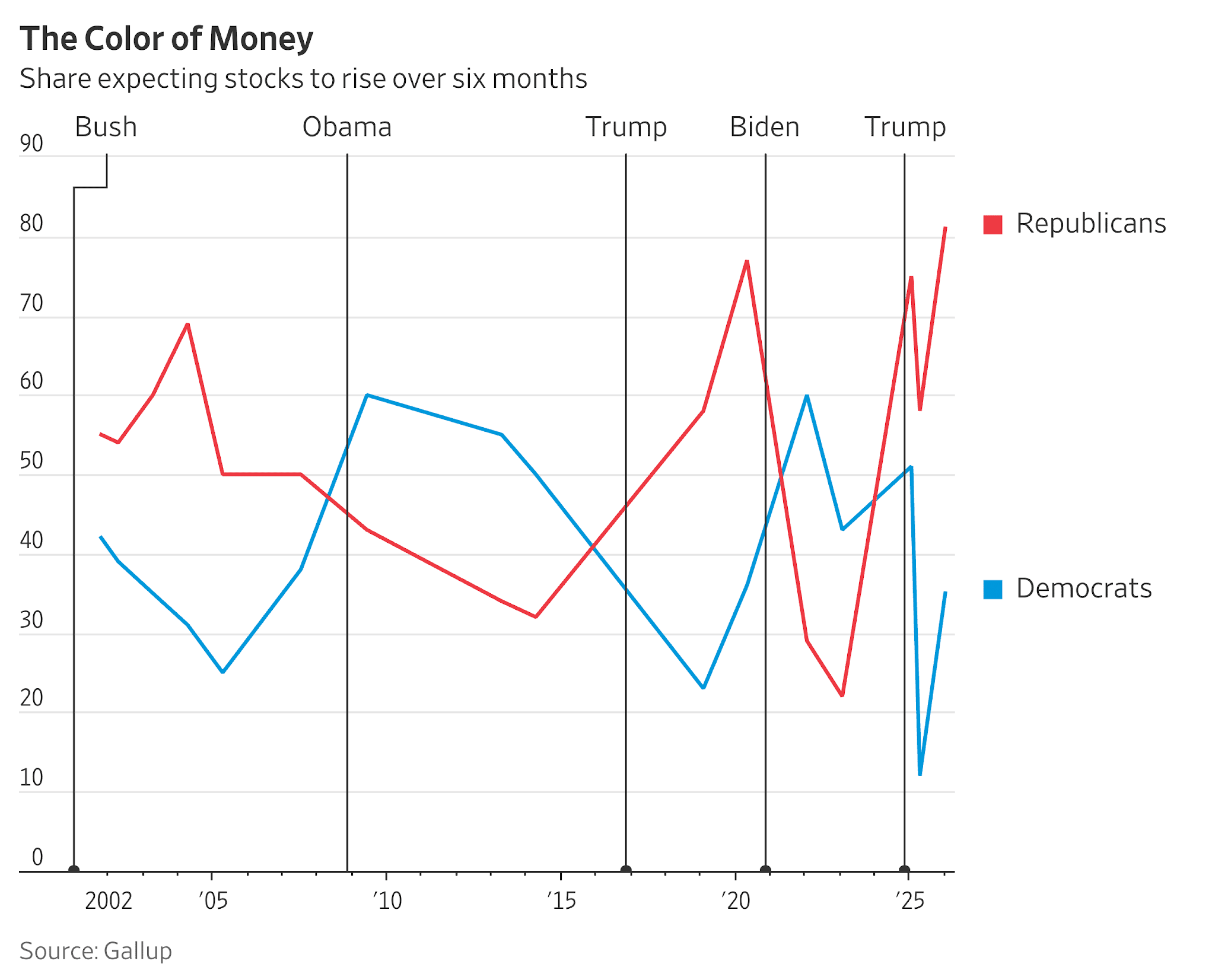
To me, nothing is more laughable and frightening than visual evidence of human fallibility. When a president from your preferred party wins the election, your perception of the economy immediately improves. When a president from the opposing party wins, your perception declines. Literally nothing has changed from November 3 to November 4, 2008, yet Democrats suddenly believed the economy was on the right track, and Republicans disagreed. And between November 7 and 8, 2016, nothing changed, but Republicans suddenly became optimistic, while Democrats became more pessimistic. If you asked people to elaborate, most would not even mention the president. They would cite whatever statistics supported their point of view. The data may not change, but the stories we tell ourselves do.
The key point is not that one side is right and the other side is wrong. Rather, it’s that both sides are experiencing the same psychological phenomenon. Facts and data exist independently of who occupies the White House, but our interpretation changes dramatically depending on our expectations, identity, and beliefs.
Now, it’s not shocking to learn that people’s views on the economy differ depending on if they agree with the current administration or not. But it’s a microcosm of our human nature that, in looking at the same economic data, people can have such wildly different results without realizing why. And with so much information at our fingertips nowadays, it’s perhaps never been more difficult to change our minds. There is always a data point or an anecdote that supports your perception, even if the perception is demonstrably false.
It’s terrifying enough on a macro level when it comes to how people view the well-being of the country. But what about on a micro level, when you’re managing your own business? If you’re stuck in your own perceptions, you can do some serious damage, especially since very few people will tell their boss that they are wrong. It’s a hidden cost of leadership. The closer you get to the top of an organization, the less likely you are to receive honest feedback.
This is especially dangerous for entrepreneurs because ownership often creates an illusion of certainty. The person who starts the company is usually the person who understands it best. They know the customers, the history, the struggles, and the sacrifices. That experience is valuable. But it can also become a trap. The same confidence that helps an entrepreneur build a company can prevent them from seeing when the company has changed.
How many small business owners make definitive statements like, “My customers don’t want that,” “X employee isn’t capable of that,” or “We’ve always done it this way”? Founder intuition is often right, until suddenly it isn’t. Recognizing that crossover moment in a given situation is one of the hardest things a business owner faces. But that’s also why successful entrepreneurs often struggle with the evolution of the market. The same instincts that helped them build the company from the ground up can also prevent them from seeing how things have changed. Experience can be a competitive advantage, but it also filters how you interpret information.
Our brains are not designed to constantly seek uncomfortable truths. They are designed to create a consistent understanding of the world around us. If we believe something to be true, it’s easy to “prove” it (because it’s psychologically uncomfortable to have to change your beliefs). If we don’t challenge our beliefs and our opinions, we’ll never improve upon ourselves and our businesses. And despite what most leaders claim, you’re never too smart or too experienced to have it happen to you.
If judges can unknowingly become harsher because they’re hungry, imagine how much your own mood affects your decisions about pricing, hiring, or firing. If a trained HR manager offers a job based on the first five seconds of an interview, rather than the entirety of its contents, imagine how quickly you can be blinded by your preconceived notions. If intelligent people can look at exactly the same economic data and reach opposite conclusions depending on who won an election, imagine how much bias affects the decisions we make inside our own businesses, where the data is often far murkier.
When you’re in charge of a small business, there is no committee stopping you from making a catastrophic decision. The buck stops with you. That’s why the best leaders actively seek perspectives that challenge their own. It’s not that they never make mistakes. It’s that they are the ones who recognize that perception of reality is not always reality itself. Do you take the extra time to look past your own beliefs and consider whether or not you are on the right track? It’s possible you are. But it’s also possible you aren’t. And only those that can effectively pump the brakes, against millions of years of human instinct, have the ability to re-focus and stop a potential derailment before it happens.
Other than the grease levels of Philadelphia’s poles.