

One of the most frustrating parts of running a business is hiring. Most leaders are not great at it in the first place – myself included. But even if you are great at it, those skills can be irrelevant. More often than not, what affects your ability to hire the most is the current state of the labor market.
When people talk about the labor market, they generally refer to the national unemployment rate or the national labor force. But these numbers aren’t helpful for a small business. My business is in New Jersey, which means California’s labor data has no bearing on how easy or difficult it is for me to hire someone. Unless you’re hiring for remote work, you care only about your own region.
The problem is, the data most covered by the media is the national data. And those data tell us that the national unemployment rate is good: between 4.3 and 4.4 percent. In fact, since the job market recovered from the pandemic closures, the unemployment rate has never been above five percent. That’s the threshold under which the Fed considers the country at “full employment.” Usually that means it’s harder for businesses to hire.

But that data only tells a small piece of the story. Hiring problems aren’t just about wages, culture, or any other national theme. In fact, if you break down the unemployment rate by state, it can range anywhere from 2.2 to 6.7, which is an enormous gap. More often than not, hiring problems are literally about how many people there are available to hire in your area.
You may be beating yourself up because you can’t seem to find new staff. I’ve got good news, though.1 Your hiring problem may not be cultural or operational at all, but rather demographic. That’s what jumped out to me when I saw some census data buried deep in a recent Wall Street Journal article:
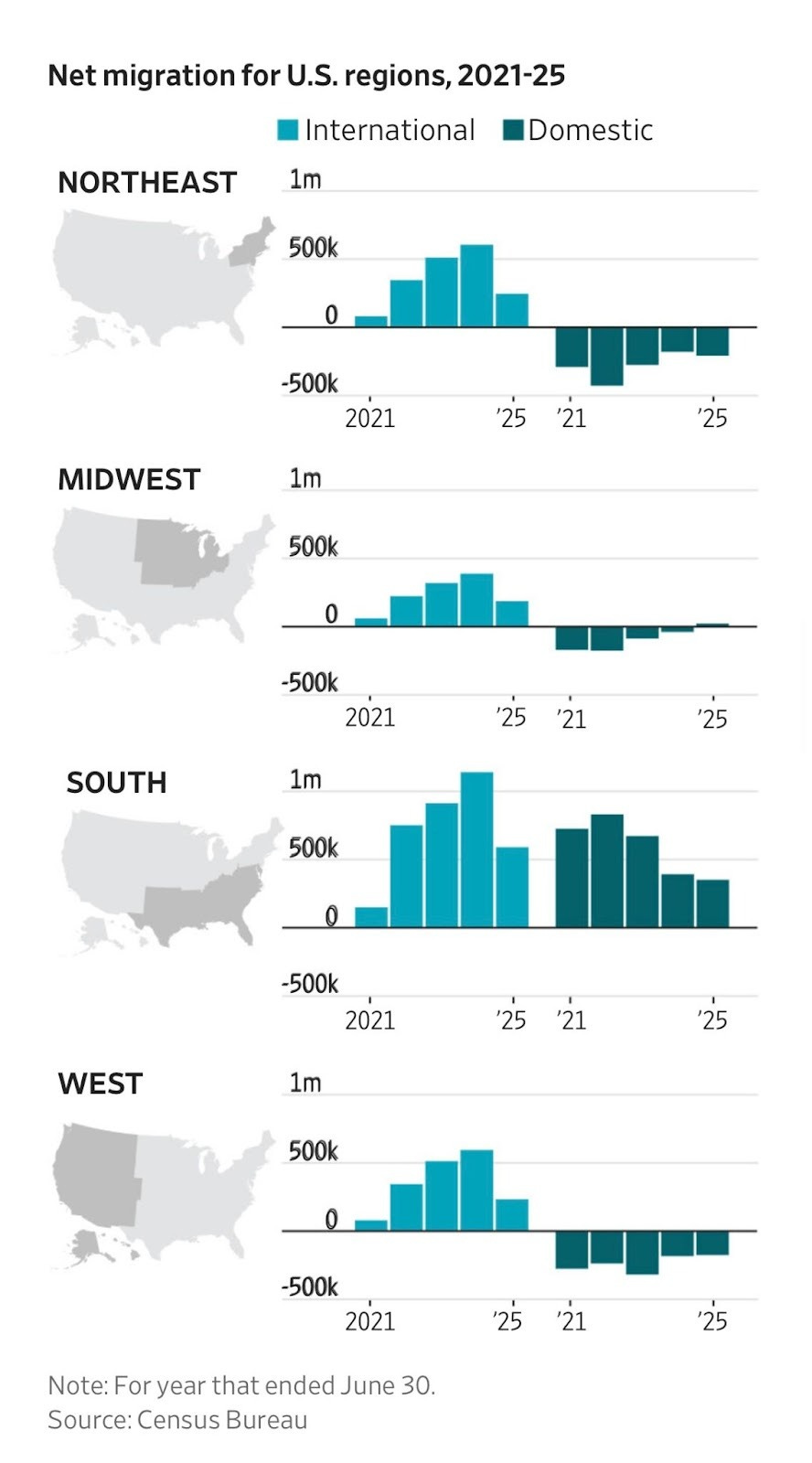
Allow me to mansplain for a moment: this chart shows net migration for each region of the country since 2021. As you can see, up until 2025, the entire country saw positive international migration, no one more than the South. But during the same time period, every area of the country saw negative domestic migration except the South. Residents that are moving are generally choosing to move to the South.
What this means is that as international migration has grinded to almost a halt in the last year, the West, Midwest, and Northeast have all seen their labor forces dwindle. The South, meanwhile, has seen a boom in their populations. This became apparent during the last two rounds of congressional reapportionment: in 2010, eight states gained seats in Congress, with only one of them (Washington) in either the Northwest or Northeast. In 2020, six states gained seats in Congress, none of them from the Northwest or Northeast. States that lost seats in 2020 include California, New York, Pennsylvania, and Ohio. Sense a pattern?
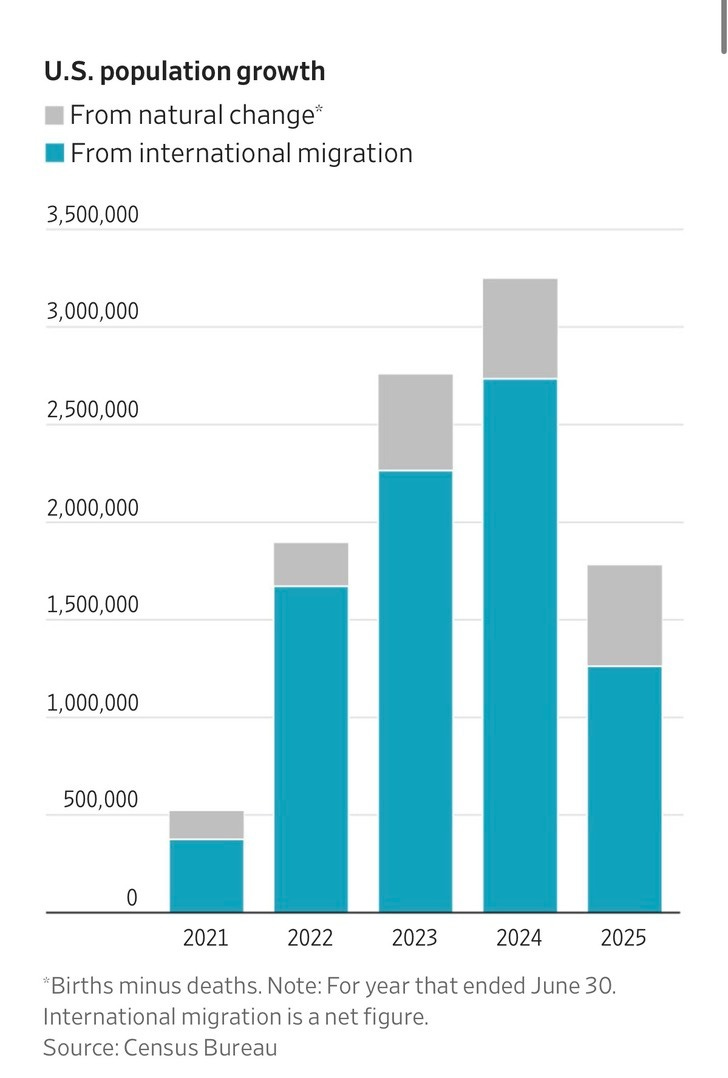
Furthermore, this second chart shows that population growth has dropped precipitously. There are a myriad of reasons behind this: a drop in legal immigration, an increase in deportations, a drop in the birth rate, and more. Now, far be it from me to discuss a political topic as toxic as immigration at this moment.2 But this data shows a problem that’s getting worse in certain regions, specifically the Northeast.
If you dig deeper into recent Census data3, you can see how the above charts contribute to a larger labor problem. Since December 2024, the labor force (the number of people available to work) has increased by just under 3 million people, but the labor participation rate (the percentage of that force actually choosing to work) has dropped by 0.1 percent. So the number of people available to work nationally has increased by less than 1 percent in the last year, which is incredibly small by historic standards. And data from Cal Matters shows that in August 2025, there were 1.4 million fewer legal immigrants living in the United States than in January 2025. That was months ago, and we can safely assume that number has only grown since then. That shrinks the labor pool even further.
If you look at the data by state, and how it’s changed between December 2024 and November 2025, 16 states had a drop in total labor force. Of those 16, 14 were located in regions outside the South. And there was only a single Northeast state that saw its labor force increase by more than one percent during this timeframe: Delaware, a state known nationally for its pro-business and pro-resident policies.
In layman terms, all of this data means a few things: first, the U.S. is not organically producing many new workers. Second, the labor supply growth is coming from people moving around the country, not births or immigration. Third, and most importantly, the people that are moving around the country are generally moving to one region – the South. Unless your business is located in Florida, Texas, or any of those other states, you’re likely having more trouble hiring than you did a few years ago.
This doesn’t create a national labor story. Rather, it creates a regional hiring asymmetry that can make it feel like you’re doing something wrong as a small business leader. But that’s not necessarily true. Here’s the landscape in 2026: a Fortune 500 company can relocate employees, sponsor visas, hire remotely, open satellite offices, and rely less on regional labor rates. Small businesses are tied to physical geography in a way that large businesses are often not. When population flows shift, small businesses get hit the hardest. And as more workers have gone remote in recent years, they’ve likely moved to lower-cost states knowing that they can continue to keep the job they have.
This is one of the reasons why, despite the strong economic data that comes out of the government, it can often feel like your region or town is struggling. The data supports that. Economic data is often national, but the small business reality is usually local. So the next time you feel like you’re doing something wrong when it comes to hiring, sure, take a look at your policies, your starting salary, your employee benefits, and any other hiring strategy you utilize.
But if all of that is in order, remember that hiring difficulty is not always a signal of competence. Sometimes, it’s simply a strategic constraint, especially when the demographics are against you.
Kind of.
I prefer this column cultivate a Main Street Mindset, not a Main Street Desire To Yell at Someone With Opposite Political Views.
The word “Census” does something to me. I admit it, I’m a nerd.