

I just got back from a trip to Disneyworld, a place I haven’t been since I was six years old. Truth be told, I love Disney, but not the way most people do. I’m not a theme park person. I never liked rides, and I still don’t love roller coasters. I’m not a sucker for Disney magic, or that mushy feeling most people get when they walk through Magic Kingdom. Instead, I’m a fan of the business: the Walt Disney Company.
I’ve admired the Disney business for as long as I can remember.1 If you invested in Disney stock back in 1962, when it traded for about six cents per share, you would have multiplied your money by nearly 1900 times by the end of 2025. The company today is worth about $200 billion and is a conglomerate larger than Walt Disney would ever have imagined back when he was drawing an odd-looking rabbit and mouse.2
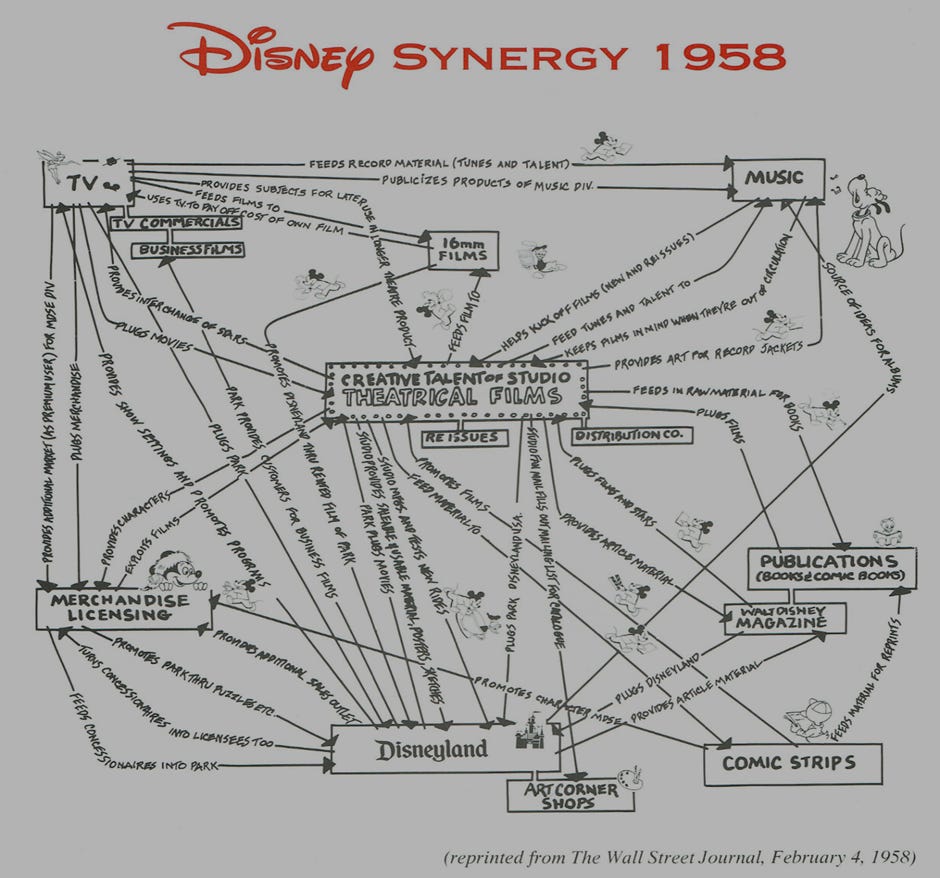
What’s most impressive about Disney to me, though, is how relatable its design is for a small business, despite its size. Disney’s biggest strength lies in its resilience and its operating system. The company’s segments operate like spokes on a wheel, with the center being its intellectual property – its studios, movies, and content. In short, its characters. Think about any part of Disney: the parks, the cruises, the merchandise, the licensing. All of it is based off of the creative side of the company. Disney’s core business is creating stories and characters. Without that, the rest of the company falls apart.
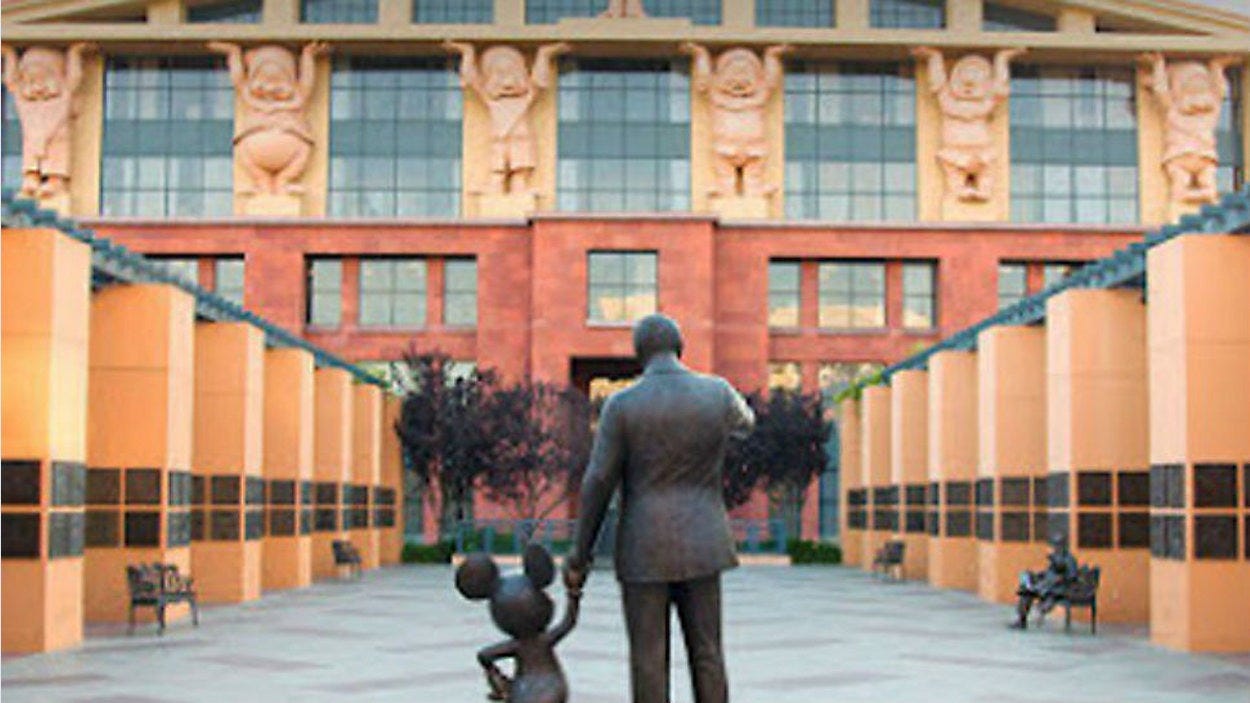
That’s why, over the last few decades, Disney has aggressively pursued acquisitions that give it access to popular IP. Here is a small selection of the companies Disney owns: Pixar, Lucasfilm, 20th Century Fox, Marvel, Searchlight Pictures, ESPN/ABC, Hulu, FuboTV, FX/National Geographic, and half of A&E (which also owns History Channel and Lifetime). That means Disney owns, in addition to all of the characters it’s created in the last 100 years, every Marvel character, every Star Wars character, every Simpsons character, a huge chunk of the global sports content, and more. These acquisitions, while pricey, expanded its core offering and allowed it to further expand the rest of its business segments using this new IP. Disney found a recipe for success and they use it over and over again.
Most importantly, this focus gives it the type of resilience that Coca-Cola and Pepsi have. Disney has survived many bumpy parts of its history, including leadership changes, strategic reversals, capex mistakes, and more. But it’s built to survive these things. It can absorb mistakes and errors, so long as they continue to focus on their core business.
This has become an issue multiple times throughout the company’s long history. After Walt Disney’s death, the company’s creativity struggled mightily. In fact, if you scroll through a list of the Disney movies from 1971 to 1988, you’d be hard-pressed to find any that you really remember. Similarly, in the early 2000s, after the musical animation boom of the 90s, Disney Animation couldn’t keep pace. Almost all of the successful Disney movies of this era were made by Pixar, which hadn’t yet been acquired by the entertainment giant.
And when Bob Iger relinquished the CEO role in 2020, his successor, Bob Chapek, made plenty of mistakes, but none worse than trying to restructure the management tree of the core business – media and entertainment. The uproar among the careerists at Disney was deafening, and within two years he had been fired by the board. When Iger replaced Chapek for his second stint as CEO, he handed creative control back to Disney’s creators.
As an investor, you could be excused for getting impatient with Disney’s stock market performance. It has lagged that of the greater market every year since 2021. But that’s exactly why I think it’s a great company to follow as a small business owner. Wall Street likes clean stories, margin expansions, and short-term clarity. But Disney lives in the long cycle. They live in the world of capital expenditures that take years to pan out. They live in the world of delayed gratification. As long as they continue to create great IP and great stories, I trust that the financial success of their company will follow along shortly thereafter.
As small business leaders, we can’t match Disney’s scale. But we can learn from their priorities.
Disney works because no single failure can take the whole system down. That’s not about scale, it’s about design. The best companies’ successes don’t hinge on one small area. It should be diverse enough that a small failure, a poor decision, or a single setback doesn’t bring the entire thing down.
Disney consistently chooses decisions that keep the institution intact, even when they don’t look optimal in the short-term. The strongest businesses make decisions based on what’s best for the long-term health of the company. Weaker companies chase sales and profit in a way that is unsustainable.
Disney found a formula that works, and keeps using it repeatedly. That’s the sign of a smart business model. That doesn’t mean they can’t make adjustments. But you should never veer away from a successful formula just because you think you’re supposed to.
Most importantly, Disney rarely loses its focus on the core business. Disney knows it struggles when its creative minds can’t keep pace. In any business, no matter how much you expand and no matter how much you diversify, you should ask yourself every day if the core business is healthy. Without it, everything downstream suffers.
One other lesson that you can take directly from Disney parks: experiences matter. I don’t mean from a grand perspective – none of us are going to be setting off nightly fireworks shows for our customers. But the next time you happen to be in a Disney park, take some time and focus on the design and operational efficiency. Look at the sightlines – you only ever see exactly what Disney wants you to see from that spot. Look at the ground – you rarely ever see a piece of trash, yet you also rarely notice a janitor walking around. Look at the lines – you spend half of your time in them, but you’re also rarely bored. Look at the way the design influences traffic flow – Disney wants people to move in a certain way, and builds accordingly.
None of us are building theme parks or cruise ships. But we all, as small business leaders, create an experience for our customers, especially if you are in a retail setting. For example, is your physical setup one that flows traffic in an ideal way? Do you present items in a way that shows your customers exactly what they should see at that moment? Does your checkout line have impulse buys or distractions in case someone is waiting a while?
The key lesson from Disney is to focus on the little things. They often matter more. Their strengths are copyable even at the smallest levels. To follow them is to follow a posture and resilience model that has endured for over 100 years.
I must be a blast to be around at parties, I know.
If you don’t know the story of Oswald the Lucky Rabbit, how Disney lost control of the character, and how it got him back nearly a century later, I highly recommend doing a Google deep-dive. It’s a great business story.